


Jussas is named after the farmer Jöns Persson, who manned the farmstead in the 1660s. In 1750 Jussas was divided between the grandson Henrik Henriksson and his brother-in-law Anders Eriksson into Jussas Österstu (east cottage) and Jussas Västerstu (west cottage). The latter became, at the beginning of the 1900s, part of the neighbouring farmstead Morbrors. The old buildings at västerstu are gone; only the old stone foundation remains. Österstu was sold in 1891 to the crofter Anders Henriksson, whose descendants still own the farmstead today. The last owner who cultivated the land and kept livestock was the farmer Bengt Nordström (1935–2023).
During the Finnish War of 1808–1809, the people of Åland initially managed to rise up against the invaders. Victory at the famous Kumlingeslaget (Battle of Kumlinge) on 10 May 1808 meant that Åland was temporarily liberated. In October 1808, King Gustav IV Adolf ordered a drastic scorched-earth policy in order to halt an expected Russian invasion. This meant that villages in the eastern archipelago were ordered to be burned down and the population evacuated to mainland Åland. While the order was not fully carried out, most of the inhabitants of Lappo still left the island in the autumn. Only at the farmsteads of Pellas, Arstu, and Jussas did people remain. At the beginning of winter 1809, Colonel Kulnev occupied Lappo. He remained for nine weeks with a troop of Cossacks while waiting for reinforcements. The soldiers were housed in all of the houses and outbuildings that were available. Kulnev himself, known from the epic poem Fänrik Ståls sägner (The Tales of Ensign Stål) by national poet J.L. Runeberg, stayed in Jussas Österstu.
The story goes that the colonel fell in love with a “vackra Anna” (“beautiful Anna”), the daughter of the house, and that this romance saved Lappo from even greater destruction. The farmer at Jussas at the time was Anders Andersson, and it may have been his 19-year-old daughter Anna who enchanted the Russian commander. Only six of the Andersson family’s 11 children survived infancy. Due to high child mortality this was not unusal at the time. “Vackra Anna” later married in 1820 and moved to Sottunga.
In March 1809, the ice drifted westward. The Russians forced the Swedish troops to flee and later conquered mainland Åland. The peace treaty, signed on 17 September 1809 in Fredrikshamn, meant that Sweden lost its eastern half of the kingdom to Russia. Lappo’s 600-year-long connection with Sweden thus came to an end.
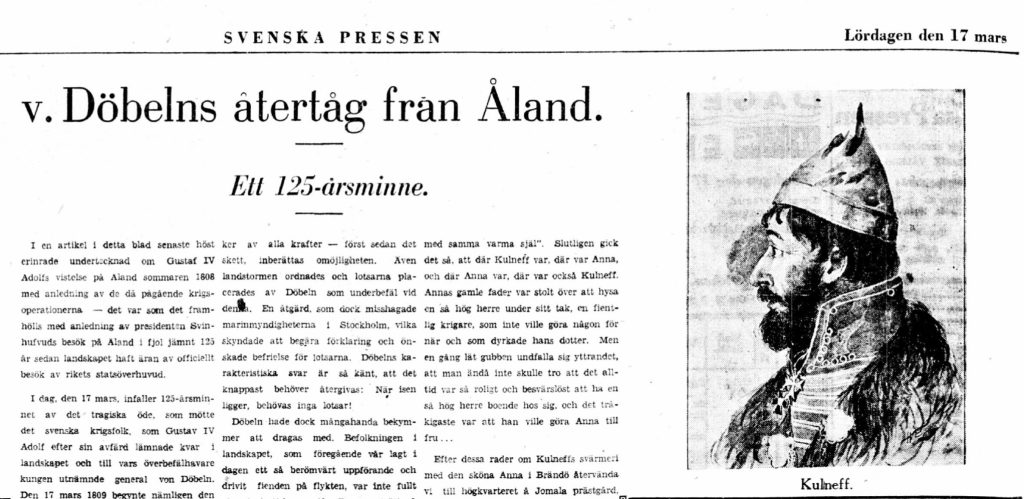
Axel Danielsson wrote about Kulneff and ”vackra Anna” (beautiful Anna) in an article for the Finland-Swedish newspaper Svenska Pressen published on 17.3.1934. Collection of Åland Museum.