


The first resident of Lappo known by name was Vaste Persson, a farmer at Pellas. Vaste Persson first appears in written sources from 1517. It is not known exactly how Pellas acquired its name, but it may be linked to one of the several farmers named Per, who over the course of the farmstead’s history cultivated the land. Pellas was a so-called “skattehemman”, a tax-paying farmstead whose owner paid taxes directly to the Crown. For a long time, the farmstead was the largest in the village and had the greatest number of livestock; in 1630 there were 20 cows and young cattle here. The farmstead at times paid taxes in money, but mainly in the form of grain, butter, pork, fish, poultry, salted Baltic herring, and labour services.
The latter half of the 19th century was a dynamic time in the Grand Duchy of Finland, marked by liberal reforms, national awakening, folk movements, and public education initiatives. These new ideas reached the village as well. Lappo folk school was founded in 1887 with Emil Nordman as teacher. Pellas soon became the village’s school building, where villagers also gathered for councils, meetings, and newspaper readings. The school, the library (1882), and the youth association (1895) became central pillars of education and of the village’s social and cultural life.
Petter Solstrand (1855–1900), who came from Pellas, trained as a teacher in Nykarleby and later worked as a teacher in Helsinki, where he also held a position as stenographer at the Diet of Finland. Nevertheless, Solstrand did not forget his home village. He documented the dialects of the archipelago, and his work “Grammatikaliskt material från Brändö och delvis äfven Kumlinge” (1880), which forms part of the Society of Swedish Literature in Finland’s oldest folklore collection, has since 2021 been included in UNESCO’s Memory of the World Register.
His son Väinö Solstrand (1882–1940) continued along the path of learning that his father had begun. Thanks to Väinö’s fieldwork in the archipelago and his archival work for the Society of Swedish Literature in Finland, the museum possesses a cultural treasure of photographs that depict everyday life in the archipelago at the beginning of the 20th century. Solstrand earned a PhD in 1925 and was appointed docent in Nordic philology at Helsinki University in 1932.
The Lappo school was built in 1958 and is located within walking distance of the village centre. However, since 2010 the schoolchildren attend Brändö school. When the school moved out of Pellas in the late 1950s, the building began to be used as accommodation for visitors. In the mid-1990s, apartments were added, and since then Pellas has operated as a popular guesthouse for tourists and groups attending courses, fishing, hiking, seeking relaxation, or enjoying Lappo’s beautiful disc golf course.
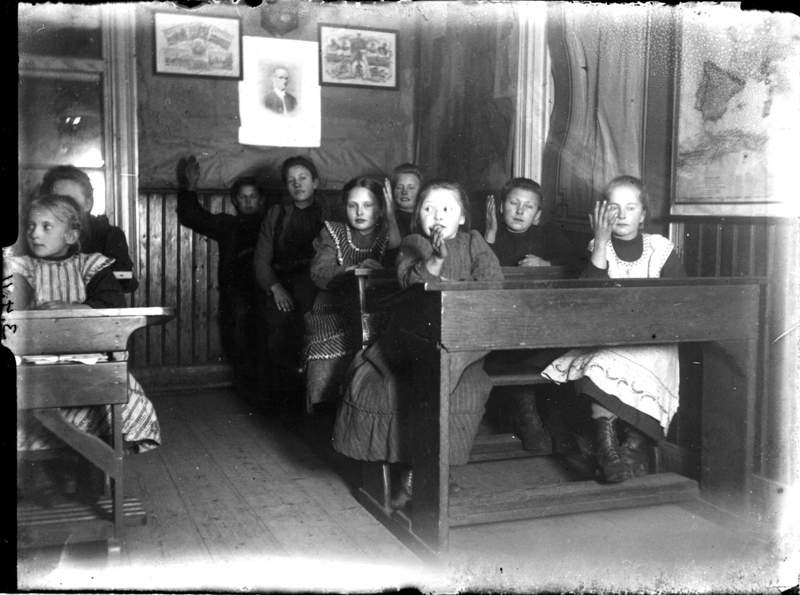
Classroom 2 at Lappo Folk School. Photo: Väinö Solstrand (1911)